Dead Joy-Con batteries at the worst possible time, we’ve all been there. Whether you’re grinding ranked matches or exploring Hyrule, a reliable controller charger isn’t optional. Your choice matters more than you’d think: the right charger keeps your controllers topped up and extends their lifespan, while a cheap knockoff can damage your battery or burn out entirely. This guide breaks down everything you need to know about Nintendo Switch controller chargers, from official Nintendo options to third-party alternatives that actually deliver. We’ll cover what separates the quality chargers from the duds, which features actually matter, and how to pick the right one for your setup and budget. Let’s dig in.
Table of Contents
ToggleKey Takeaways
- A quality Nintendo Switch controller charger extends battery lifespan and prevents costly replacements ($70–$80 per pair), while cheap chargers risk degradation and safety hazards through poor voltage regulation.
- Official Nintendo docks guarantee compatibility and reliability but charge slower (3.5–4 hours), whereas third-party options deliver faster charging (2.5–3 hours), multi-controller support, and better value at competitive prices.
- Modern Joy-Cons support USB-C direct charging for ultimate flexibility, making this ideal for travelers, though you sacrifice the convenience of simultaneous multi-controller charging.
- Look for chargers delivering at least 5V/1.5A output with overcharge protection, proper heat dissipation, and durable contact points to ensure safe, efficient charging and long-term durability.
- Battery health improves by avoiding complete drain cycles, maintaining cool storage temperatures, and rotating usage across multiple controller sets rather than relying on one pair constantly.
Why Choosing The Right Controller Charger Matters
Your Joy-Con batteries degrade with every charge cycle. A cheap charger might seem fine initially, but improper voltage regulation or cheap circuitry can accelerate that degradation, leaving you with controllers that don’t hold a charge after a year or two. That’s not just inconvenient, it’s expensive. Replacing a pair of Joy-Cons runs you $70–$80, so protecting what you have makes financial sense.
Beyond battery longevity, the right charger speeds up your playtime. Nobody wants to wait four hours for controllers to recharge when you’ve got a weekend gaming marathon ahead. Quality chargers with fast-charging tech bring batteries from dead to full in half the time of standard options. They also run cooler and more safely, reducing the risk of overheating, a real concern with lithium batteries.
There’s also the convenience factor. If you’re juggling multiple controllers, a dock that charges four Joy-Cons simultaneously beats swapping between USB cables. Professionals and casual players alike benefit from having backup power ready to go. When tournaments or multiplayer sessions depend on charged controllers, cutting corners on your charger setup is asking for trouble.
Types Of Nintendo Switch Controller Chargers
Official Nintendo Chargers
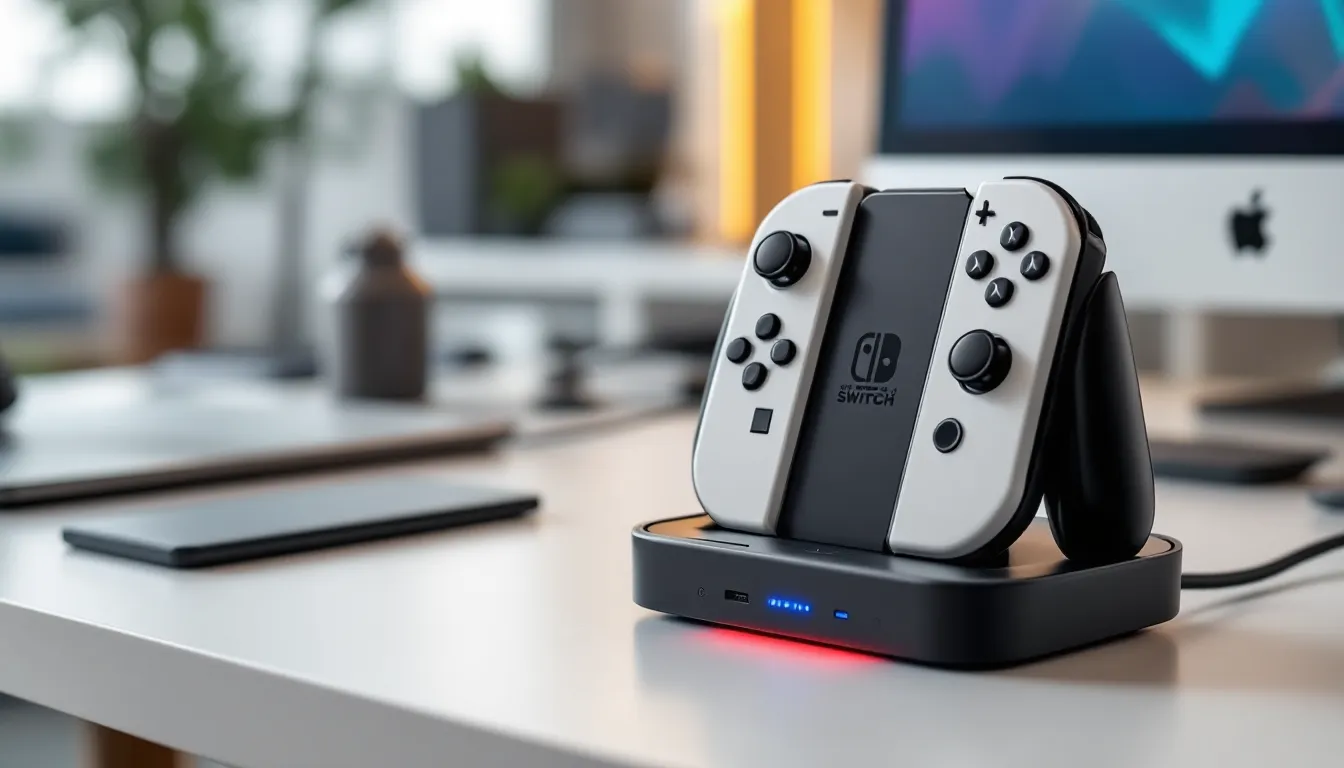
The Joy-Con Charging Dock is Nintendo’s standard solution. It sits on your desk, charges two Joy-Cons simultaneously through spring-loaded contacts, and comes bundled with most Switch packages. The design is simple, plug it in, drop your controllers in, and they charge passively while you play handheld or dock your Switch elsewhere. Build quality is solid, and compatibility is guaranteed since Nintendo made it.
The downsides? Charging speed is deliberate, not fast. The dock takes roughly 3.5 hours to fully charge a pair of Joy-Cons from empty. If you’re swapping controllers mid-session, that wait stings. The dock also doesn’t support Pro Controllers, so if you use those (and many competitive players do), you’ll need a separate solution.
Third-Party Charging Docks
Third-party manufacturers have filled the gap Nintendo left open. Many docks charge multiple Joy-Cons and Pro Controllers simultaneously, with charging times that often beat the official dock. Premium options include LED indicators showing charge status, compact designs that save desk space, and better heat dissipation to protect your batteries.
The catch? Quality varies wildly. Some third-party docks use substandard components that can damage controllers or create safety hazards. Look for docks with proper certification, user reviews confirming reliability, and clear warranty terms. Reputable brands like Nintendo Switch Tools: Essential Accessories and Utilities for Every Gamer vendors ensure you’re getting products that won’t fry your controllers.
USB-C Direct Charging Options
Modern Joy-Cons (models post-2019) support USB-C charging directly. You can charge them using any USB-C cable without a dock, just plug in and go. This is the most flexible option for travelers or players who want to minimize desk clutter.
The tradeoff is convenience. Without a dock, you lose the visual charging status and can’t charge multiple controllers simultaneously. You’re also handling individual cables for each controller, which gets messy fast. USB-C charging works, but it’s best paired with high-quality cables that support proper voltage delivery. Cheap USB-C cables can throttle charging speed or damage batteries through unstable power delivery.
Key Features To Look For When Selecting A Charger
Charging Speed And Efficiency
Charging times vary significantly across chargers. Official Nintendo docks hit full charge in 3.5–4 hours. Better third-party options deliver 2.5–3 hours through optimized circuitry. Some premium docks claim sub-2-hour charging, though real-world results depend on the dock’s power adapter.
Watts matter here. Look for chargers that deliver at least 5V/1.5A output per port. This ensures your controllers charge at their optimal rate without thermal stress. Overcharging protection is non-negotiable, modern chargers should cut power automatically once batteries hit 100%, preventing battery puffing or degradation.
Durability And Build Quality
A charger gets plugged in daily, so construction matters. Metal contact points resist corrosion better than bare copper. Rubberized feet prevent the dock from sliding across your desk. Cable management, whether through clips or grooves, keeps things organized without stressing the power cable at the connector.
Check reviews for long-term durability reports. Controllers should slide in and out smoothly without excessive resistance that could wear down contact points. Some docks use spring-loaded contacts that can loosen over time: others rely on friction-based designs that hold stronger but risk damaging Joy-Con contact pins if forced.
Compatibility And Design
Not all chargers work with all controllers. Original Joy-Con models use different contact layouts than newer versions. Pro Controllers have their own charging specs. If you own multiple controller types, and most Switch owners do, verify your charger handles all of them.
Design ergonomics matter too. A dock that fits your controller’s grip width prevents controllers from tilting during charging, which can stress contact points. LED indicators let you glance over and see which controllers are fully charged without having to pick them up. A compact footprint is huge for players with limited desk space.
How To Properly Charge Your Nintendo Switch Controllers
Battery Health Tips
Lithium batteries benefit from moderate charge cycles. Avoid letting your Joy-Cons completely drain regularly, if you’re only using them once weekly, top them off even if they’re at 50%. Conversely, don’t leave them plugged in constantly. Modern overcharge protection helps, but unnecessary cycles still degrade batteries over time.
Temperature matters. Keep chargers away from direct sunlight and heat vents. If a charger gets hot to the touch during charging, disconnect it immediately, that’s a sign of electrical issues. Store controllers in a cool, dry place. Humidity can corrode contact points and cause charging failures.
Rotate your controllers if possible. If you main one pair and ignore backups, you’re cycling their batteries harder. Spreading usage across multiple controller sets extends everyone’s lifespan.
Troubleshooting Common Charging Issues
Controllers not charging? First, inspect the charging contacts on both the controller and the dock. Dust and debris accumulate there, a soft, dry cloth usually fixes it. If contacts are corroded or discolored, isopropyl alcohol on a cotton swab carefully applied can help restore conductivity. Never use water.
Charge one controller then immediately switch to another. Some docks have firmware or contact issues affecting specific ports. If only one dock port works, the dock itself is likely failing. Test the controller on another charger or dock to isolate whether the problem is the controller or the charging hardware.
Slow charging usually points to a weak power adapter or a cable issue. Try a different USB cable if you’re using USB-C direct charging. Test the dock on a different power outlet, wall outlets themselves can malfunction. If the charger is years old, it’s worth replacing: lithium chargers lose efficiency with age. Reference Nintendo Switch Tips: Get More From Your Console for additional optimization strategies.
Official Vs. Third-Party: Which Is Right For You
Nintendo’s official Joy-Con Charging Dock offers guaranteed compatibility and rock-solid reliability. You know exactly what you’re getting: spring-loaded contacts, proper voltage regulation, and build quality that lasts. If you want zero risk and don’t mind slightly slower charging, the official dock is worth the investment.
Third-party chargers excel in value and features. You’ll find docks that charge four controllers at once, support Pro Controllers, offer faster charging, and cost less than the official option. Brands with strong reviews and clear warranties, verifiable through independent reviewers like Tom’s Guide, deliver quality competitive with or exceeding Nintendo’s offering.
The key difference? Risk versus flexibility. Official Nintendo chargers eliminate compatibility guessing but offer fewer features and slower speeds. Third-party options demand a bit of research to avoid duds, but reward that research with better specs and value.
Your choice depends on use case. Casual players who charge controllers overnight don’t need speed, the official dock works fine. Competitive players managing multiple controllers, or anyone needing fast turnaround between sessions, should look at third-party docks with faster charging and multi-controller support. Travelers benefit from USB-C direct charging to minimize bulk. There’s no universally “best” option, only the right option for your setup. Players exploring Nintendo Switch Strategies: Tips to Elevate Your Gaming Experience often discover that controller management is crucial to maintaining peak performance.
Budget-Friendly And Premium Charger Recommendations
Budget Tier ($15–$25)
If you’re hunting for the cheapest option that doesn’t compromise safety, look for USB-C charging cables certified by organizations like the USB Implementers Forum (USB-IF). A quality USB-C cable paired with any reliable 5V power brick works perfectly. Cost is minimal, and you gain flexibility, charge anywhere, anytime. The downside is you lose the convenience of a dock.
For actual budget docks, search for third-party options with 50+ reviews averaging 4+ stars. Avoid anything with obvious red flags: generic seller names, missing safety certifications, or reviews mentioning overheating. Reputable budget docks from established brands run $20–$25 and deliver solid performance.
Mid-Range ($25–$50)
This tier offers the sweet spot for most players. You get proper multi-controller charging (usually 2–4 controllers simultaneously), faster charging than the official dock, and proven reliability. Many support both Joy-Cons and Pro Controllers, eliminating the need for multiple chargers. Premium builds include LED status lights, compact designs, and strong warranty coverage.
Look for docks from brands with established reputations in gaming accessories. Reviews across PCMag and similar tech sites validate performance claims. At this price point, you’re also getting better customer support if something fails.
Premium Tier ($50+)
High-end chargers offer features designed for competitive players or anyone demanding maximum convenience. Ultra-fast charging (sub-90-minute full charges), charging for six or more controllers, wireless charging integration, and premium materials justify the higher cost. Some include temperature sensors that prevent overheating, and RGB lighting for aesthetic appeal.
Premium doesn’t always mean better for casual players, you’re paying for redundancy and features you might not use. But, professionals managing equipment for tournaments, streamers with multiple controller sets, or anyone with four or more controllers benefits from the throughput and reliability.
Conclusion
Picking the right Nintendo Switch controller charger comes down to matching your needs with the right solution. Official Nintendo chargers offer simplicity and guaranteed compatibility. Third-party docks deliver better features and faster charging at competitive prices. USB-C direct charging works for travelers who don’t mind cables. Understanding your usage patterns, how many controllers you manage, how quickly you need them charged, and how much desk space you’re willing to dedicate, makes the decision straightforward.
Invest in a quality charger, treat your batteries well, and your Joy-Cons and Pro Controllers will stay reliable for years. Cheap chargers might save $15 today, but replacing controllers due to battery damage costs significantly more. With options across every budget, there’s no reason to settle for subpar charging hardware. Whether you’re exploring the best Nintendo Switch options or optimizing your existing setup, a solid charger is foundational to uninterrupted gaming.